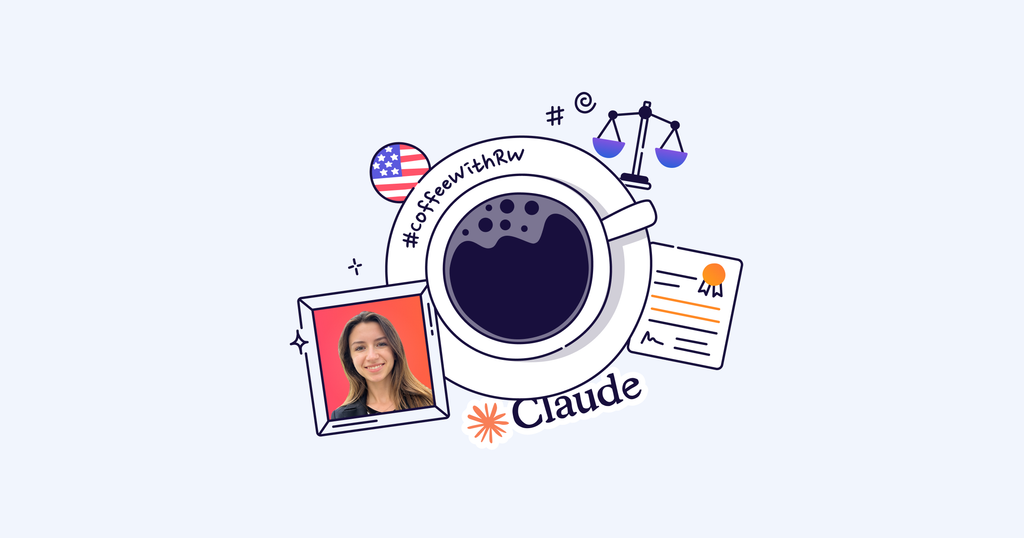
We often chase a passion for a field instead of truly mastering it, getting lost in day-to-day work. However, Nadia Rohalska, Legal Counsel at Railsware, found her own comfortable balance. She managed to combine a career pivot away from studying law with earning two master’s degrees (one from Chicago-Kent College of Law, Illinois Institute of Technology) while continuing to grow within her team and explore new areas.
Last time, we talked with Yuliiana Dobosh, Product Marketing Manager, who opened up about her own not-so-linear journey from chemistry classes to law school, startup chaos, product marketing, and even using AI to study Korean.
This time it’s a completely different field, but just as interesting. Over to our colleague Nadia.
A genuine passion, legal studies, and first steps into IT world
Most law careers start with a spark of passion. For some people it fizzles out fast, but mine never really did.
My passion for law started in 9th grade, when we first studied it as a school subject. I was hooked by its logic, clear structure, and cause-and-effect relationships. Before applying to university, I was already competing in law competitions at the national level.
When choosing a university, I followed the rankings and enrolled in the Department of Prosecutorial Studies, the largest department within the law faculty.
Editor’s note: Unlike in the US, Ukrainian legal education allows students to specialize early. Nadiia’s degree focused on prosecutorial studies, with an emphasis on criminal law and procedure.
Spoiler alert: the program was genuinely fascinating, but somewhere along the way I realized it wasn’t where my future was headed. That didn’t stop me from throwing myself into everything else on offer: the legal clinic, student organizations like the Students’ League, winter internships at a law firm. It was there, during that internship, that I got my first real look behind the curtain: onboarding clients as a legal advisor, clients from the tech industry included.
My colleagues taught me plenty, and I soaked it up. I could feel the gap between what I was learning in class and what I was doing on the job. Two completely different worlds. However, that didn’t disappoint me. I figured out what I wanted, and by the time I graduated, I was already pursuing a spot at a legal firm.
Once I got there, I worked with all kinds of clients, no two profiles alike. Consulting had its own relentless vibe, but eventually I hit a ceiling. As an outside advisor, your influence only stretches so far before the door closes.
So, almost by accident, I stepped through a different door — in-house, at a startup.
Startup Life: building the plane while flying it
When the COVID pandemic hit, plenty of consulting businesses found themselves staring down real risk. And lawyers were not spared.
That’s when I started looking for a new role, and joined a startup.
During my time as an advisor, I’d already picked up on the communication style and processes typical of young technical teams (something that really stands out once you’ve spent time in the legal world), and it always resonated with me.
However, the startup threw something new into the mix. I wasn’t just adapting to a culture — I was building the processes from scratch, while juggling collaboration with a dozen different teams at once.
Gone was the office full of lawyers speaking the same jargon. Now I had to meet each person where they were. Translate, negotiate, explain, so that everyone was rowing in the same direction. And because the startup was growing at breakneck speed, I was constantly walking the tightrope between “what the team wants” and “what’s actually safe.” That’s where my stakeholder-communication muscles really got a workout.
That crash course in in-house life turned out to be exactly what I needed. And from there, I moved on to my next chapter: Railsware, a product studio with more than 15 years on the market, yet still throwing fresh curveballs that pushed me to rethink how I prioritize.
Back to school: continuing my education in the United States of America
Ask any lawyer: finding time to read something new, let alone sit down and really dig into research, is nearly impossible. Still, the idea of a master’s program in the U.S. had been sitting in the back of my mind for years. It wasn’t a “tried once, got in, done” kind of story, either. I kept circling back to the idea until I was eventually accepted to Chicago-Kent College of Law, Illinois Institute of Technology.
My team had my back the whole way. They understood why I wanted to take this step, gave me the space to do it, and welcomed me back with new knowledge and a slightly different way of looking at my work.
The program itself was split into two stages: I spent the first full year studying remotely from Ukraine, followed by a year in the U.S., studying in person. I had already fallen for the professors and their teaching style. It felt worlds apart from what I knew back home, not just in the subjects, but in how the material was approached and discussed.
The program also gave me quite a bit of freedom to shape my studies around what actually interested me. Most of the courses were electives I could choose based on my interests and professional needs.
One elective I found particularly valuable was U.S. corporate law. It gave me a much deeper understanding of common law practices in that area, with its history and reliance on legal precedent.
We looked at what happened before, why a particular decision was made, and how that precedent can help you understand the situation in front of you.
I also took two courses that were especially relevant to where the legal profession is heading: “AI for Law” and “Law for AI.” “AI for Law” was the more hands-on course, focused on AI as a tool lawyers can actually use. I especially enjoyed getting more comfortable with how these systems work under the hood.
“Law for AI” flipped the perspective. Instead of asking how lawyers can use AI, we looked at how the law is trying to keep up with AI itself — from regulation and policy to the broader questions around governing the technology. It’s a field that is changing so quickly that if I took the exact same course again today, parts of it would probably already look different. That pace of change is part of what makes this area so interesting.
Along the way, I also got a front-row view of how quickly legal tech is developing. It’s becoming a strong business direction, with new hybrid legal-technical roles emerging — people who combine legal expertise with responsibilities in legal operations, AI literacy, technology adoption, and policy-building.
And I could see the connection with my own work, too. The experience pushed me to think more deliberately about how AI can support everyday legal tasks, rather than simply treating it as another tool to experiment with.
I became more comfortable working with Claude and, just as importantly, more interested in documenting repeatable workflows and building AI literacy and fluency within Railsware.
So, in a way, going back to school didn’t mean stepping away from my career. It gave me a chance to look at it from a different angle, just as law and technology themselves are increasingly becoming impossible to separate.
Advice for lawyers eyeing a move into tech
Looking back, three things stand out as the real lessons from this whole journey.
- Brace yourself for a moving target.
Don’t assume your background has fully prepared you for whatever’s coming. Contexts shift constantly: different specializations, different practices. This isn’t a world where you handle one thing before lunch and something completely unrelated — say, a court case in California — right after. You need to be quick on your feet, ready to get up to speed on new product processes and new ways of working with users, clients, and colleagues alike.
That adaptability only gets you so far, though, if you can’t bring people along with you, which is really the second lesson.
- Learn to speak everyone’s language.
From day one, you have to learn how to explain, discuss, and break down complex processes into words that actually land for the person in front of you. It’s easy for lawyers to get lost in the weeds of jurisprudence, but the colleagues coming to you for help usually don’t need or want the deep dive.
And underneath both of those is something easy to lose sight of once the day-to-day takes over.
- Whatever you do, don’t let the spark go out.
I’ll leave you where I started: finding time to experiment and learn something new is genuinely hard when you’re constantly keeping one eye on what the team needs. But that spark is worth protecting. It’s what keeps you curious, and in the long run, it’s exactly what sharpens your instincts and makes you better at the job.
FAQ
How do lawyers move from consulting into in-house or startup legal roles?
Many make the shift after building experience advising clients across different industries in consulting, then move in-house when they want more ownership over outcomes rather than staying purely advisory. The transition usually means building processes from scratch and learning to communicate across teams that aren’t made up of other lawyers.
What skills are necessary for a successful career in a legal team of a tech company?
Strong communication tops the list, being able to translate complex legal concepts into language that product, engineering, and marketing teams can actually use. Adaptability matters just as much, since priorities and specializations shift constantly, along with comfort navigating ambiguity and a genuine curiosity about how the technology itself works.
Do lawyers moving into the tech industry need a technical background?
Not necessarily. What matters more is a willingness to learn new processes, translate legal concepts for non-legal teams, and get comfortable with whatever tools and workflows a company already uses.
How is AI changing legal roles inside companies?
AI is creating new hybrid positions that combine legal expertise with responsibilities like AI literacy, policy-building, and legal operations. Much of the work centers on documenting repeatable workflows and building responsible practices around AI use, rather than replacing legal judgment.
How does Railsware use AI like Claude in its legal work?
Since 2026, Claude has been part of Railsware’s corporate AI toolkit, used to document repeatable workflows and support research and day-to-day legal tasks, as part of a broader push to build AI literacy across the team.