

Let’s face it: writing for B2B SaaS can sometimes feel like you’re trapped in a jargon jungle. If I have to read the words transformative, cutting-edge, or streamline one more time, I might actually delve into madness. With AI creating new content after learning from millions of B2B SaaS texts, the job isn’t getting easier.
It’s time to admit that the “Golden Age” of SaaS features is over. In a market where every CRM, ETL solution, and dev tool looks and performs almost identically, the battle for the user’s attention has moved from the codebase to the interface.
But there’s a problem. Most B2B SaaS copy has devolved into a “Sea of Sameness.” If you’ve ever navigated a digital landscape of empowering workflows and seamless integrations, you know what I mean. No wonder users have developed a cliché blindness, just like we all adapted to ignore ad banners before ad blockers became a thing. When everyone is next-gen, absolutely no one is.
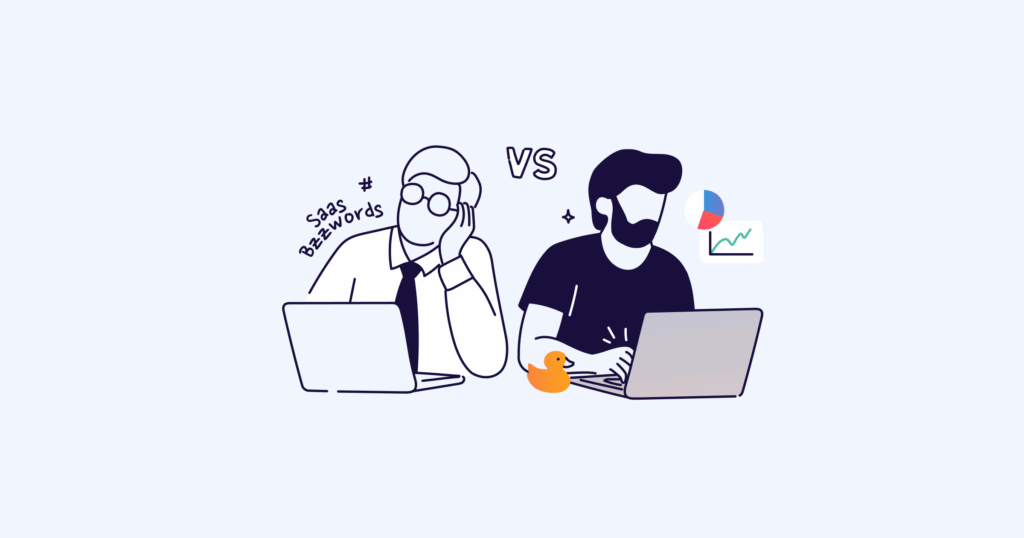
At Railsware, we believe copy is a functional component of the product. It’s the UX layer made of words. To cut through the noise, we went straight to the source. We interviewed four expert copywriters, people who have spent years crafting texts for pricing pages, product blogs, onboarding flows, and churn-reduction emails.
We didn’t ask them for generic best practices (“Know your audience”, well, duh!) We asked them for the dirt: the industry clichés that make them cringe, the micro-copy tweaks that actually move the needle, and the rituals that keep them sane.
Here are some takes on B2B SaaS copy from those who mastered this art.
Steal like an artist from angry Reddit threads

Years in the industry: 14+
Current projects:
B2B SaaS procurement platform, AI B2B quoting SaaS, and project management app for law firms
Vibe:
Home office or a cafe with a sweeping view of the river or city skyline
“Deep work” soundtrack:
Trance DJ sets (Miss Monique and Korolova for standard output, scaling up to Tiësto when the tasks get tough)
Stefan’s lifehack number one to focus when starting to write is a psychological trick: Just start reading or typing. He intentionally makes his brain find the project interesting. Even if it’s the driest, most highly technical B2B content on the planet, Stefan insists there is always an interesting angle hiding in the weeds.
The “cringe” factor: stroking founders’ egos
He admits that he’s allergic to overused vague, abstract, “cool-sounding” words: transformative, revolutionary, next-gen – you know it.
“These people don’t understand that the goal of copy is not to stroke the founders’ egos,” Stefan notes. “It’s to capture attention, establish connection, create conviction, and get the readers to click the button.”
His antidote to founder-ego copy? Laser-specificity. If it’s not ultra-relevant to the person holding the credit card, delete it.
The micro-win: the “safety net” under the CTA
Stefan’s favorite “invisible” hack is using the negative space directly beneath a CTA button. He adds microcopy to intercept objections and reiterate the core value proposition right at the point of highest friction.
A few of his go-to formulas that have significantly boosted conversion rates:
- [Get started for free]
… and save ≅10 hours of work each week! - [Book a call]
… and see why Fortune 500 brands hire us. - [Book a demo]
*a 20-min, no-obligation demo
This tiny safety net reminds the user exactly what they are getting into — and what they stand to gain.
Avoiding “SaaS-brain”: mining the trolls for gold
To keep his copy human, Stefan spends 2-3 extra hours doing something most brands avoid: reading negative comments. He scours G2, Reddit, and niche forums to see what users actually care about (which often completely surprises the product team). This helps him nail the exact wording and tone of the target audience. In fact, his research is so effective that he has found perfect H1 headlines hidden in angry Redditors’ complaints. It takes extra time, but it drastically cuts down on editing later.
AI vs. human: the Shakira principle
What can a human do that AI can’t?
Coming up with a brand new angle, experimenting, and having fun.
As proof, he once successfully used the lyrics from Shakira’s Whenever, Wherever to promote a logistics SaaS. Good luck getting an LLM to hallucinate that connection. Because AI is fundamentally designed to find the most repeated patterns in large datasets, it is literally built to produce the median — “mediocre, good enough copy.”
Yet, Stefan isn’t anti-AI. He uses it for brainstorming, surgical micro-edits, and proofreading. But to write killer, conversion-heavy copy? You still need a human brain (and maybe a little Tiësto).
The “off-switch”
After all that deep work, reading angry Reddit comments, and writing Shakira-inspired logistics copy, how does Stefan actually unplug? His “off-switch” is a mix of high-energy and high-chill. To completely clear his SaaS-brain, you’ll either find him screaming at a Crvena Zvezda Euroleague basketball game, grabbing drinks with friends, or just chilling on the balcony with his wife.

Years in the industry: 8
Current project:
data integration and AI analytics platform Coupler.io
Vibe:
The classic home office
“Deep Work” soundtrack:
Pure, unadulterated silence
With eight years in the industry and currently driving growth for a data-focused product, Zakhar has zero patience for copywriting theater. He doesn’t need bells, whistles, or magic formulas to get the job done. Just clear logic and a quiet room.
Zakhar’s number one ritual to focus when starting to write? Absolutely nothing. No Pomodoro timers, no app blockers, no elaborate coffee-brewing ceremonies. He just sits down and does the work in total silence. It’s a level of raw discipline that most of us (with our curated Lo-Fi beats) can only dream of.
The “cringe” factor: the “last-minute” pitch
Since Zakhar manages a lot of freelance writers, his biggest pet peeve is the “casually pushed” SaaS promotion. You know how it looks: 1,500 words of beautifully written educational content, followed by a sudden, “Oh, by the way, buy our software” at the very bottom of the page.
To Zakhar, content that only brings value to the reader but zero pipeline to the business isn’t marketing–it’s charity work. The frustration isn’t just about the content itself. It’s about the writer’s failure to understand the fundamental logic of product-led content. If the product isn’t woven into the actual solution of the article, the copy has failed.
The micro-win: the “macro” truth about buttons
When asked about his favorite micro-win, Zakhar was frank: He doesn’t have one.
“We played with different button colors, positions, styles, CTA blocks, etc. It did not work,” he admits. Instead of chasing the mythical “red button converts 10% better” fairy tale, Zakhar focuses on the foundation.
What actually moved the needle for Coupler.io was properly introducing the user’s problem and writing a lean, BS-free explanation of the solution. As it turns out, you can’t A/B test your way out of a confusing value proposition.
Avoiding “SaaS-brain”: the irritation indicator
Zakhar’s anti-burnout strategy relies on a highly calibrated internal metric: his own patience. His rule is simple:
If I get irritated quickly by some tiny things, it’s a sign to get on vacation.
If you’re snapping at a misplaced comma or a slow-loading Google Doc, it’s time to close the laptop and book a flight.
AI vs. human: the subtraction problem
While AI is great at generating bulk, such as descriptive or educational paragraphs, Zakhar points out that it fails miserably at subtraction.
“AI struggles with cutting off a bunch of words to deliver the very idea of a certain statement,” Zakhar explains.
Trying to use AI for punchy micro-messaging or turning bloated paragraphs into a single, razor-sharp sentence is an exercise in frustration. To get a good short phrase out of ChatGPT, you usually have to Frankenstein three different outputs together. Humans still hold the absolute monopoly on brevity, Zakhar believes.
The “off-switch”
After a long day of hammering away at way-too-long freelance drafts, wrestling with wordy AI outputs, and focusing in total quiet, Zakhar doesn’t need some big routine to recharge. His ‘off-switch’ is just hanging out with his family. What can I add? A simple, human way to end a day full of logic and thought.
Put CTAs early to catch intent

Years in the industry: 10+
Current project:
productivity tools for Jira TitanApps.io
Vibe:
Home office, plus the occasional coffee shop run
“Deep Work” soundtrack:
It depends on the day: either absolute silence or a steady deep house mix
With over a decade in the industry, Victoria knows that surviving in B2B SaaS requires a healthy dose of realism. She isn’t here to romanticize the craft, but to get things done. Victoria’s lifehack number one to focus when starting to write is beautifully simple: she relies on her ecosystem. She flips her Apple devices into “Work Focus” mode, shutting down the outside world, notifications, and distractions in one tap. From there, it’s just her, the blank page, and maybe some deep house.
The “cringe” factor: the AI myth
If there’s one narrative Victoria is tired of reading, it’s the overblown promise of “AI orchestration agents.” You know the pitch: the software will magically do all the heavy lifting, and you can just sit back, sip a latte, and watch the algorithms run your business. After ten years of writing about complex topics, she knows this is a massive cliché. Software requires management, input, and oversight. Promising a hands-off utopia just sets the user up for disappointment.
The micro-win: capturing high intent early
We are often taught to build a narrative, educate the reader, and place our Call to Action gently at the bottom of the page. Victoria’s experience throws that rule out the window.
One of her biggest micro-wins was simply moving CTAs to the very beginning of the article. While she doesn’t track the exact percentage every time, this single structural shift consistently drives higher conversion rates in the marketplace. Perhaps, high-intent readers don’t want to scroll through 1,500 words just to find the signup link, so why not give it to them right away?
Avoiding “SaaS-brain”: deliberate context switching
Writing about B2B software all day can easily fry your brain. To avoid the B2B SaaS fatigue, Victoria relies on variety. She deliberately mixes her workload, bouncing between highly complex technical topics and lighter, easier pieces. She also breaks up the monotony by mixing writing with totally different operational tasks. Changing gears keeps her brain from stalling out.
The AI reality check and the “off-switch”
When asked what humans can do that AI never will, Victoria goes against the grain: in the long term, she believes, pure copywriting could actually be substituted by AI. But there is a massive catch. The real moat isn’t the ability to string words together. It’s deep, native knowledge of the product. To survive, Victoria believes writers must evolve into T-shaped specialists on the go, combining broad marketing skills with deep product expertise.
And after a long day of navigating the future of AI and balancing complex technical writing, she powers down her Apple devices. Her off-switch is purely analog: a good walk, a solid gym session, or just brewing a cup of tea and getting lost in a good book.
Trade soft idioms for hard facts

Years in the industry: 6
Current project:
data integration and AI analytics platform Coupler.io
Vibe:
Home office (for now)
“Deep Work” soundtrack:
Piano jazz
Yana has spent the last six years mastering the art of getting users to actually care about data integration. She knows that in a world full of noisy, overlapping tools, the writer who maintains the sharpest focus wins.
Her lifehack for concentrating when starting to write is borrowed from cognitive management: she refuses to multitask. Instead of drowning in twenty browser tabs, she starts her day by tackling the most complex task first. That’s what they often call “eating the frog.” From there, she relies on focused single-tasking and regular, intentional switches between activities to keep her mind sharp.
The “cringe” factor: the AI fingerprints
Nothing makes Yana want to close her laptop faster than spotting the obvious, lazy fingerprints of AI generation. If a text asks her to delve into a topic or promises to streamline a process, she’s already checking out. Sometimes running a draft through an AI detector first can flag those fingerprints before a reader ever has to.
Even worse? Generic examples backed by absolutely zero proof. In B2B SaaS, if you can’t back up your bold claims with hard data or a real-world use case, you aren’t doing marketing, you’re just writing fiction.
The micro-win: the power of the ticking clock
When it comes to getting users to take action, vagueness is the enemy of conversion. Yana proved this with a brilliant micro-win in an email campaign dedicated to tax forms. The original subject line was a classic, although vague nudge: “It’s high time.” Yana swapped it out for actionable specificity: “3 days till deadline.” The open rate spiked significantly. By trading a soft idiom for a hard deadline, she manufactured instant urgency.
Avoiding “SaaS-brain”: developing editorial taste
Writing about abstract software every day can slowly erode your creative instincts. To prevent this, Yana completely steps outside the SaaS echo chamber. She actively reads articles by authors known for their high-quality writing, such as Ahrefs’ famous essay on the concept of “taste” in marketing. Exposing her brain to “tasteful” texts resets her baseline and sparks fresh approaches for her own technical articles.
The AI reality check and the “off-switch”
If you want to know what AI will never be able to replicate, Yana has a simple answer: authentic humor. While large language models can generate millions of words a minute, asking one to be genuinely funny usually just results in a massive facepalm. Humans still own the monopoly on making a reader actually smile.
And speaking of being human, Yana’s routine for shutting down after a long day of piano jazz and deep work is all about active, tactile engagement. She unplugs her SaaS-brain entirely by diving into rapid online chess and taking dance classes – a perfect antidote to a heavily digital day.
So, what actually works in B2B SaaS copy?
After hearing about decades of collective experience from our experts (and taking notes on their eclectic Spotify playlists), a clear pattern emerges.
Writing high-converting B2B SaaS copy isn’t about knowing the right magic words. In fact, it’s mostly about knowing which words to delete. It’s about fighting the urge to sound like a Silicon Valley visionary and choosing instead to sound like a helpful human sitting across the desk from a very tired product manager.
If we distill the operational dirt from our experts into a survival guide, it comes down to key rules:
1. Kill the buzzwords (before they kill your conversion rate)
If your product description includes the words seamless, streamline, next-gen, or asks the user to delve into anything, hit the backspace key. Specificity is the ultimate conversion lever. Vague promises stroke founders’ egos. Meanwhile, hard numbers, exact deadlines (“3 days left”), and radical transparency get the credit card.
2. Sweat the micro stuff
Nobody is excited to read a pricing page. The real battle is won in the unglamorous sentences and overlooked spaces. Offer guidance instead of a dead end, experiment with the safety-net microcopy beneath the “Book a Demo” button, and place the CTA exactly where a reader is ready to make a decision. You can’t A/B test your way out of a confusing value proposition, but a well-placed tooltip can absolutely save a churn risk.
3. The human upper hand is product knowledge (and Shakira)
AI is incredibly good at adding words, but it is remarkably bad at subtracting them. It won’t mine Reddit for angry customer quotes to turn them into proper wording or synthesize a complex feature into a five-word punchline. It definitely can’t add pop lyrics into logistics software. To survive the AI wave, businesses often partner with an experienced digital marketing agency to refine website messaging, and writers must become T-shaped operators who understand the product architecture as well as they understand grammar.
4. For the love of copy, touch some grass
You cannot write empathetic, human-centric text if your brain is permanently stuck in “SaaS mode.” Whether it’s woodworking, heavy lifting, piano jazz, online chess, or screaming at a basketball game, every single expert we spoke to relies on a hard, analog “off-switch.” Creative longevity requires stepping away from the screen.
At Railsware, we build tools like Coupler.io and Mailtrap on the exact same philosophy: high-quality info, low noise, and zero tolerance for BS. We believe that whether you are writing code or writing copy, the goal is exactly the same — to solve the user’s problem as efficiently as possible.
And if you like the approach, come help us build (and write about) products like Mailtrap and Coupler.io – check our openings here. We promise we’ll never ask you to use the word “streamline” in a headline.