
People love to say your first years of work are exciting. In reality, they often feel like a constant search for the right people, the right opportunity, and a place where you can actually grow. And lately, that search has only become harder. AI is reshaping the way we work, so expectations keep rising, and competition for junior roles has roughly doubled in the past two years.
Every year, Railsware welcomes a new group of marketing interns into Outreach, PR, and SEO. Over the past five years, we’ve hired 24 people for these roles, and many have since grown into middle and senior specialists who help shape our products and processes.
This article looks at what it takes to land a marketing internship in 2026. Also, it takes you behind the scenes of ours: who we look for, how we hire, what the experience is really like, and how that first role can become the foundation of a career.


TL;DR
- Landing a marketing internship is harder than ever. The average internship drew about 109 applicants by late 2024, nearly double two years earlier.
- Railsware runs marketing internships across Outreach, PR, and SEO, on products like Mailtrap, Coupler.io, and TitanApps.
- We hire for mindset over experience: ownership, curiosity, and “do what makes sense” thinking matter more than a polished CV.
- Most interns stay and grow. Since 2020, we’ve hired 24 marketing interns, 22 of them are still here months later, and several have moved from intern to senior specialist.
- AI raised the bar but made interns more valuable.
How hard is it to get a marketing internship in 2026?
According to Handshake’s Internship Index, the average internship drew around 109 applicants by the end of 2024 (up from 62 a year earlier and just 43 the year before). At the top, the odds start to look like a lottery: Goldman Sachs accepted about 0.7% of applicants to its latest class, and Google fields over 125,000 applications a year.
Demand is tightening, too. Internship postings dropped more than 15% between 2023 and 2025, even as the share of graduates applying for at least one climbed from 34% to 41%.
Yet getting in is only half the story. Across the market, only about 55% of interns say they’d want to stay where they interned (NACE, 2025), fewer than two in three feel they’re paid fairly, and roughly one in five never gets a mentor.
So the real scarcity is internships worth staying for. NACE found that interns satisfied with their experience are about five times more likely to accept a full-time offer. A good program does make the difference between training someone for your competitor and building your own team.
Who makes a great marketing intern?
At Railsware, we don’t expect interns to have a long list of achievements, years of experience, or a perfectly polished CV. That’s not what internships are for.
What we look for are the qualities that make people successful at Railsware (yes, even at the very beginning of their journey):
- Ownership. You care about the outcome, not just completing a task. You take responsibility, follow through, and look for ways to make things better.
- A “do what makes sense” mindset. You don’t just follow instructions – you think, ask questions, use facts and data, and can explain your decisions.
- Comfort with the unknown. New challenges don’t scare you. You can enter an unfamiliar area, learn quickly, and figure things out.
- Openness to feedback. You’re ready to ask questions, recognize when something can be improved, and use feedback as a way to grow.
- Self-direction. We trust people to make decisions and move things forward without constant supervision. We look for those who can take initiative and find their own path.
- Care for the craft and the people around you. You’re curious about becoming better at what you do, and you care about working with others. At Railsware, you’ll be part of a team of 200+ people across 25+ countries, so collaboration and empathy matter.
The most important quality in an intern is the ability to think and understand quickly. If someone can grasp cause-and-effect fast, they’ll very likely make it through hiring.


We don’t expect work experience or deep theoretical knowledge. Hard skills move to the background, and we develop those during onboarding. What we really need is curiosity. It’s a crucial skill for an intern, and it grows fastest in people who arrive knowing very little.

How we hire marketing interns at Railsware
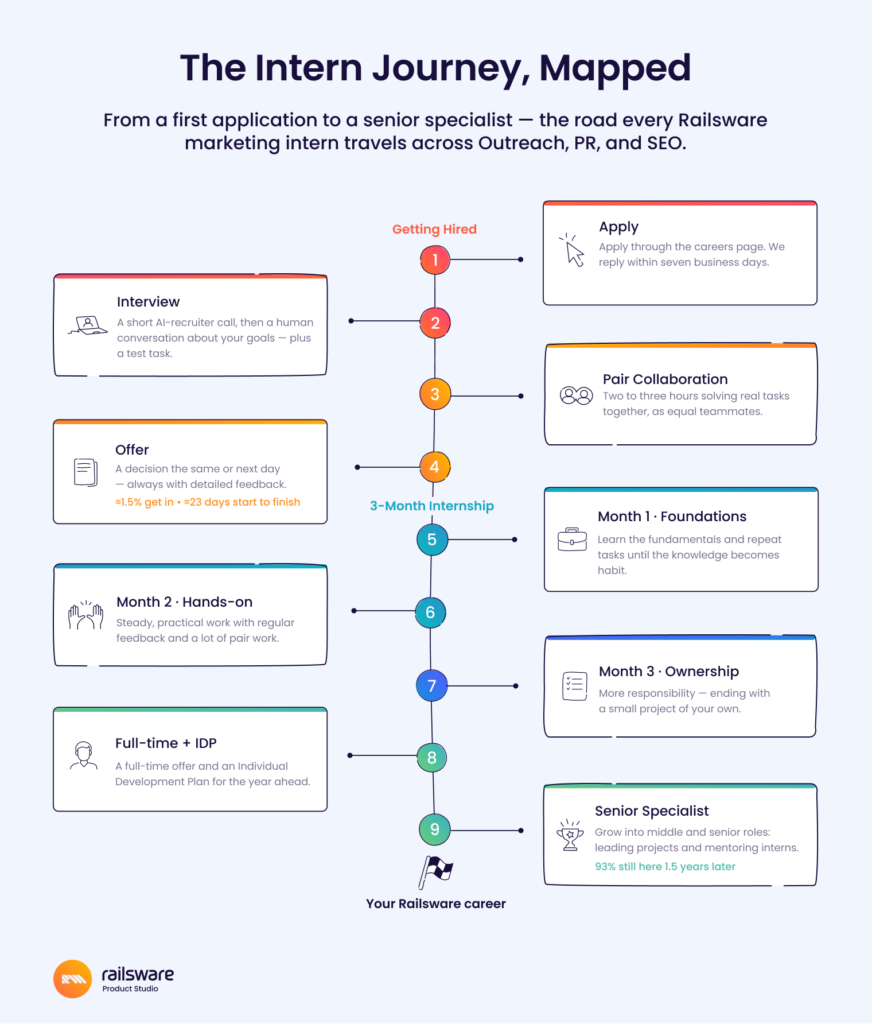
To find a marketing intern that matches Railsware approaches, we built a collaborative process that sets expectations early and lets both sides see whether it’s a real fit. Four steps:
1. Application
Apply through our careers page, and our recruitment team gets back to you within seven business days. We also keep an eye on job boards and communities, so sometimes we reach out first.
2. Interview
We start with a short call with our AI recruiter just to get the basic info about your experience and aspirations, and then we move to the human-to-human conversation about your skills, your motivation, and the job you’re actually dreaming of. It’s a dialogue, not an exam, so ask us anything about the team and how we work. Depending on the role, there may be a short test task.
3. Pair collaboration.
Pair work runs through everything we do, so this step mirrors the real thing: you and a Railswarian work through a few hands-on tasks as equal teammates, not to catch you out, but to see how you think and collaborate. It usually takes about 2–3 hours.
4. Offer
We share our decision and detailed feedback on the same or the next day. The bar is real as we hire roughly 1.5% of applicants, and it takes about 23 days on average to bring an intern on board. Yet, the constants are simple: at least upper-intermediate English, genuine motivation to learn, and strong soft skills. And the process is meant to feel human from the first minute.
Everyone at Railsware went through this hiring process, and it can seem as long and demanding. So the first thing I do is build trust. I want people to know I’ve been through it too.
What the marketing internship looks like and how interns grow into seniors
At Railsware, an internship isn’t a stack of small, disconnected tasks. It’s a deliberate three-month arc designed to take you from “I’ve never done this” to owning real work.

A lot of how well an intern does really comes down to how clearly their coordinator has mapped things out — I’d say that’s more on us than on them, honestly. We try to set success criteria to SMART from the start, and then keep checking in with weekly feedback.


The first month is about building a solid theoretical foundation: you learn the fundamentals and repeat similar types of tasks. This way, your knowledge turns into habit, rather than facing something completely new every day. The second month is about putting that into practice with steady, hands-on work. By the third month, the goal is to work much more independently. That’s when we start layering in extra responsibilities, and toward the end of onboarding, you’re usually handed ownership of a small project.
In the beginning, people mostly do what we brought them on for, but it’s not really fixed. As someone gets quicker at something, that opens up a bit of time to try other things, whether that’s link building, analytics, whatever they find interesting. There’s space to explore. And if someone comes and says they’d like to try a certain direction, we’ll usually find a way within a guild it’s pretty easy.
Five things make this process work:
- Knowledge sharing and a lot of pair work.
You’re not left to sink or swim. Early on, information comes in bits: live sessions, guides, and walkthroughs, while your team helps you find your footing. This is why we practice pair work, as it runs through everything we do. You learn the products, tools, and culture by working next to experienced Railswarians, not by reading about them.
I try to make onboarding as gradual and structured as possible. We start from zero, and by the end of the second month, it’s usually clear how the person is progressing and what their growth trajectory looks like.
I split onboarding into two main phases. The first phase is about learning. The first weeks are dedicated to getting to know the team and how we collaborate.
From the second week onward, the focus shifts to hands-on work. New team members start with small, recurring tasks they’ll continue to own over time. We gradually increase the complexity through iterations, helping them build confidence while receiving regular feedback along the way.
- Documented processes
A lot of what you need already exists: our Handbook, process guides, and product docs. So you’re rarely blocked waiting for someone to explain the basics. By documenting how we work, we create space for people to take initiative, solve problems independently, and take ownership far sooner.
The first week is mostly dedicated to learning the documentation and getting familiar with our approach. From day one, we give interns the freedom to explore the tools at their own pace. The goal isn’t to memorize everything, but to understand how things work. We review the same concepts throughout onboarding during tasks, syncs, and dedicated learning sessions, making the process gradual and practical.
We also include product demos and hands-on time to explore the product independently, often using tools like Claude, since our audience is developers.
- Regular feedback sessions.
We’re a feedback-driven team, so feedback isn’t a once-a-year event. In your first months, you’ll have recurring sessions (roughly monthly to start, often weekly one-to-ones) that go both ways:
you hear how you’re doing, and you tell us how our processes are landing for you.
The thing I watch most is how someone responds to feedback and reflects on their own work. I always ask people to assess themselves first and remind them that mistakes are part of learning.
Newcomers often overthink a miss or get anxious when they fall short of a target, but what matters is what they take from it. And in link building, you never “learn it all,” so strong fundamentals plus a constant eye on what to improve is what counts.
- An Individual Development Plan (IDP).
Once you’ve found your feet, you and the team map out where you want to grow over the coming year, turning “I’d like to get better at X” into concrete goals. It’s the difference between drifting and deliberately leveling up, and a big part of how interns move toward middle and senior.
When it comes to development, I’m not a big believer in courses. By the time someone reaches their IDP, they’ve already been through three months of onboarding, which is one big course in itself. My approach is to hand people the fishing rod: I help to set the direction and the tasks, and from there they do the work, find their own solutions, and come to me with ideas. Sometimes that means letting someone make a mistake and then unpacking together what went wrong and when. The one thing I’m always careful about is never squashing their initiative.
We are transparent about where an internship can lead and discuss potential career paths from the start. At the same time, we encourage people to first build strong foundations in their current role before expanding into new areas.
We regularly use self-assessments and feedback sessions to understand whether someone is ready for more responsibility. If we see they have both the ability and the motivation, we’ll give them more ownership. We also look beyond task output: self-management, work organization, and professional habits are just as important as technical skills, and these goals often become part of each person’s development plan.
- Monthly sharing sessions.
Once a month, marketers from across Mailtrap, Coupler.io, and TitanApps get together to share what’s working, what isn’t, and what they’ve learned. And it is the fastest way for an intern to see how marketing plays out across very different products.
Behind that system are coordinators who take real responsibility for guiding each intern. Both of our marketing leads describe onboarding the same way: start light, teach how to fish rather than handing over the fish, and let the direction emerge.
Where can a marketing internship lead?
The best way to understand where an internship can go is to hear from people who started exactly there as marketing interns and grew into specialists shaping our products today.
From outreach intern to PR specialist at Mailtrap
When Sofiia joined Railsware as an outreach intern, she didn’t have a five-year career plan. She’d studied marketing, interned at the National Bank of Ukraine, and completed a digital marketing program covering everything from SEO to PPC.
After several interviews built around brain teasers and abstract logic puzzles, Railsware’s process felt different and transparent. Instead of trying to outsmart candidates, the team invited her to solve a real task together, ask questions, and have an honest conversation with the people she’d actually be working with.
The biggest challenge came after she joined. Mailtrap was built for developers, and without a technical background, understanding the product and its users was not easy.
The hardest part, honestly, was understanding the product. I’m not a developer. I had never touched code. So I sat down with our blog, registered for Mailtrap, and worked through the email protocols until it all started to make sense.

That depth quickly turned into initiative. As an intern, she noticed the team’s cold outreach wasn’t fully GDPR-compliant and, a little nervously, proposed the fix that’s still in place years later.
From there, her path opened up: outreach, then event management, then influencer outreach and PR when a teammate moved on.
For me, PR really comes down to building relationships with people, that’s the heart of it. And I got there just by trying things, not by mapping out where my talent was supposed to be.
Looking back, she’s clear about what let her grow and what she’d tell anyone applying today.
What mattered most to me early on was feeling safe: knowing what I was doing and what success looked like. When expectations are blurry, you feel blurry too.
If I were applying now, I’d go to the company’s site, find their socials in the footer, and just scroll for a while. You can learn so much about a team and their values that way.
From career switcher to marketing intern and senior outreach specialist at Coupler.io
Stevan’s path into marketing started with an unexpected career change. After studying Serbian language and literature and spending several years teaching, he realized academia wasn’t the only place he wanted to grow and build his future. A friend’s recommendation led him to Railsware, where he took his first steps into marketing through an internship.
The beginning came with its own challenges. After years of being the person with the answers in the classroom, becoming a beginner again required a different mindset. There were new tools to learn, unfamiliar processes to understand, and plenty of feedback to absorb. But once Stevan embraced that learning curve, everything started to fall into place.
He discovered his strength in link building and gradually grew from completing tasks to owning relationships with agencies, managing blog collaborations, and helping others who were just starting their own journeys. Today, he’s a Senior Outreach Specialist at Coupler.io, with SEO becoming the next chapter of his growth.
Having been a professor, teaching people isn’t new to me, but it’s still a privilege and a responsibility. You’re helping someone make the most of their internship and giving them the best possible start.

From generalist to senior outreach specialist at Coupler.io
When Nadiia joined Coupler.io, she wasn’t starting over. She was looking for a place where she could keep growing. She already had marketing experience from working at a small startup, where being part of a two-person team meant learning to do a little bit of everything. It was exciting, but it also meant there weren’t many people around to learn from or ask for guidance.
This time, she was looking for something different: a team with experienced people, opportunities to learn, and the space to go deeper into the areas that interested her most. SEO was one of them, and outreach felt like the perfect place to start exploring it.
One of the first things that stood out to her was the freedom to explore. Development plans weren’t limited to predefined tasks, they encouraged people to choose projects they were genuinely curious about, even if they stretched beyond their current role.
That freedom came with its own learning curve. Deciding what was worth pursuing, turning ideas into projects, and figuring out priorities wasn’t always straightforward. But knowing there was always someone to ask made experimenting feel much less intimidating.
Most people don’t naturally sit down and map out their own development. Having a mentor and a structured development plan makes a huge difference. It gives you direction, helps you prioritize what to work on next, and builds confidence along the way.

As time went on, Nadiia realized she’d reached the point where link building alone no longer challenged her. Instead of going deeper into one niche, she began expanding sideways: adding SEO initiatives and, eventually, influencer marketing, which has become her primary focus today.
Maybe we’ll meet soon
The funny thing about curiosity is that it tends to lead you somewhere good.
For us, it has led to a small internship program where people don’t just spend a few months learning. They stay, grow, and build careers. Since 2020, almost every intern we’ve hired has become part of our team, with several growing into senior roles.
Maybe one day that’ll be you.
Until then, keep exploring. Visit our blog whenever you’re looking for practical insights, and keep an eye on our careers page and social channels LinkedIn or Instagram for the next internship opening.
We’ll be cheering for your curiosity either way.
FAQ
Do I need a marketing degree or experience to intern at Railsware?
No. We hire marketing interns for mindset rather than credentials: curiosity, ownership, initiative, and comfort with the unknown. Marketing knowledge helps, but hard skills are something we actively teach and develop throughout the internship.
What is the Railsware marketing internship hiring process?
Four steps: apply via the careers page, with a reply within seven business days; an interview about your experience, motivation, and goals + test task; a 2–3 hour pair-collaboration session working through real tasks as equal teammates; an offer with detailed feedback, usually the same day or the nex
How long is the internship, and what happens after?
The internship lasts around three months. If it’s a mutual fit, you’ll receive an offer to join the team full-time and start building your Individual Development Plan (IDP) to support your long-term growth.
Is it possible not to receive an offer after the internship?
Yes, sometimes that happens. An internship is an opportunity for both sides to understand whether the match is right. Even when someone is talented and works hard, the environment, expectations, or type of work may simply not be the best fit. Much like a plant that thrives in one environment but not another.
What skills do marketing interns need now that AI exists?
Being comfortable with AI tools is becoming a basic professional skill, but critical thinking matters even more. AI can help with research, drafting, and routine tasks, but judgment, creativity, and the ability to verify information are still essential.
What does Railsware look for in a marketing intern?
Ownership, a “do what makes sense” mindset, comfort with the unknown, openness to feedback, self-direction, and care for the craft and the people around you. Above all, hiring managers point to curiosity and quick, cause-and-effect thinking.
What can a marketing internship at Railsware lead to?
Many interns continue growing into specialist and senior specialist roles. Former marketing interns have gone on to become PR Specialists at Mailtrap and Senior Outreach Specialists at Coupler.io, leading agency relationships, influencer marketing initiatives, SEO projects, and mentoring future interns.
How many interns stay after the internship?
Since 2020, most of the marketing interns Railsware hired stayed on past their trial, and about 93% of everyone we hire is still with the company a year and a half later.