
Silicon Valley has been the place for American tech for over thirty years. Even in 2025, there were almost 700,000 tech professionals packed between San Francisco and San Jose. No wonder everyone used to say: if you want to crush it in tech or hire the best engineers, you head to the Valley.
However, the sheer size of the place doesn’t tell the whole story anymore. Look closely at what companies are actually hiring for, and you’ll see a massive shift happening in the U.S. tech scene. The market isn’t just about one huge hub anymore. Instead, it’s splitting into specialized local clusters, each one driven by its own industries, performance goals, and unique technical needs.
To figure this out, the Railsware team dug into search patterns for over 50 tech-specific hiring queries across every U.S. state from January to November 2025. The results completely challenge the old “big hub vs. remote” way of thinking. What we’re seeing is a map of serious technical expertise popping up way outside the Bay Area. To get more insights, keep on reading!


Where the most developer action is happening
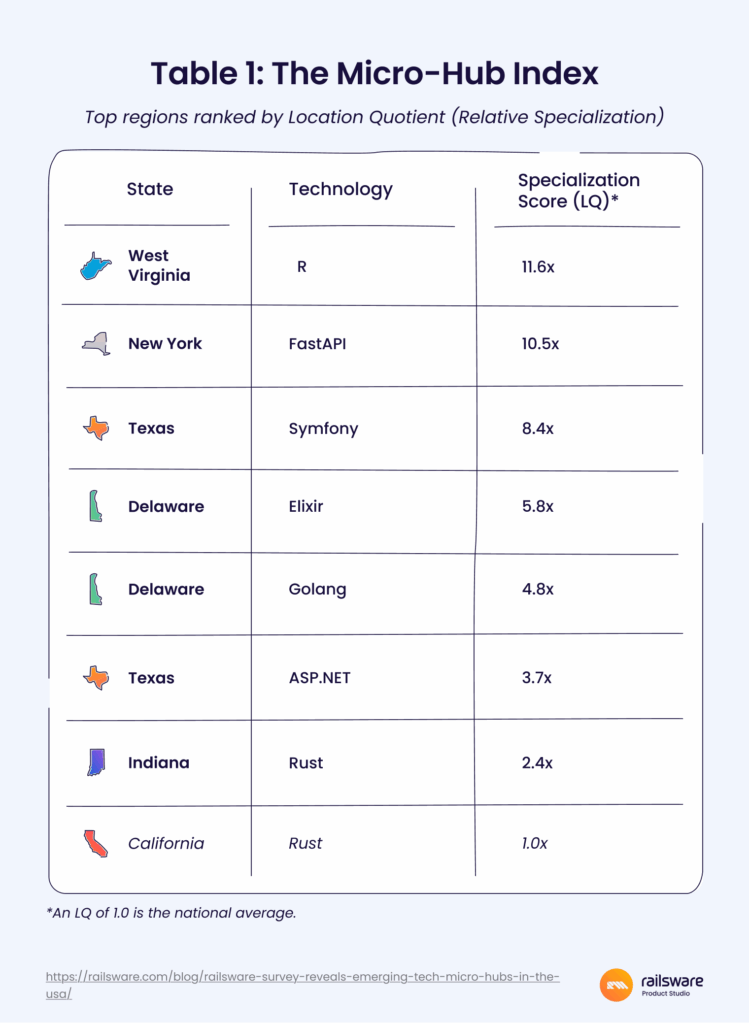
To really show this change, we created the Micro-Hub Index. It ranks states using the Location Quotient (LQ), which basically tells you how much more concentrated a specific tech skill is in a certain area compared to the whole country. An LQ of 1.0 means a state is right on the national average. Anything higher means they specialize. The bigger the number, the more unusually concentrated that skill is in a particular state.
The first thing that jumps out is that the strongest signals aren’t coming from California at all.

West Virginia really loves R developers
West Virginia tops the list with an LQ of 11.6x for R. That means R-related hiring is through the roof, more than eleven times the national average when you look at their overall tech scene.
This isn’t just about standard corporate analytics. We’re talking serious statistical heavy lifting for things like energy modeling, public health studies, regional planning, and policy deep dives. When the focus is on being totally transparent, reproducible, and methodologically solid (more so than just shipping fast), R is still the go-to tool.
West Virginia’s high ranking suggests it’s less a place for building shiny products and more a powerhouse for analytical work. It’s where the data gets crunched, interpreted, and validated before it goes out to inform big decisions elsewhere.
The state totally dominates the list with an LQ of 11.6x for R.
New York: FastAPI at 10.5x, engineering for speed
New York comes in second, with a Location Quotient (LQ) of 10.5x for FastAPI. That’s a lightweight, high-performance Python framework perfect for building fast, low-latency services.
How so? It totally clicks with what finance needs: think lightning-fast trading systems, risk engines, market data pipelines, and real-time analytics. In this world, every millisecond counts. These systems must reliably handle massive, continuous data streams under significant load.
This aligns perfectly with the technical demands of finance: trading systems, risk engines,
Unlike tech hubs focused on pumping out features or chasing user growth, New York’s tech stack has a laser focus on something else: speed and responsiveness. The fact that FastAPI shows up so much isn’t random. It’s a clear signal of the city’s “performance first” engineering mindset.
Texas: Big-time enterprise tech
Texas appears twice in the top spots, each time pointing to enterprise-grade systems:
- Symfony: 8.4x
- ASP.NET: 3.7x
Symfony’s strong presence suggests that there are many large, long-lived web applications. Think internal platforms, customer portals, and those compliance-heavy systems run by mature companies, not just early-stage startups.
ASP.NET confirms the pattern: we’re talking enterprise software, internal tools, and corporate systems where things like stability, security, and long-term maintenance matter more than just quick experimentation.
Taken together, these numbers tell us Texas isn’t just a cheaper version of California. It’s building its own tech scene, one that’s optimized for organizational size, staying power, and reliability, rather than simply exploring the next big product idea.
Delaware: the backbone of transactional systems
Delaware also appears twice:
- Elixir: 5.8x
- Golang: 4.8x
Both technologies are known for handling concurrency, reliability, and high-throughput systems. Elixir powers fault-tolerant, distributed systems that remain available under failure. Go, on the other hand, is a star at fast, concurrent services that scale predictably.
It’s no accident that they’re both strong here. Since Delaware is the legal and corporate base for so much of American business, it’s where all those mission-critical backend systems are concentrated. Think transaction processing, account management, regulatory reports, and interbank comms–the stuff that absolutely cannot fail.
Basically, Delaware runs the transactional nervous system for US enterprise software. You don’t see it, but the economy couldn’t run without it.
Indiana vs. California: What’s up with Rust’s 2.4x vs. 1.0x?
The most interesting comparison here has to be Rust.
- Indiana: 2.4x
- California: 1.0x (national average)
California’s Rust presence mirrors the national norm. Indiana’s, by contrast, is more than double.
This pretty clearly signals that Rust (a popular choice for memory safety, performance, and reliability) isn’t just being driven by Silicon Valley’s startup hype. Instead, it’s being pulled into places where software has to deal directly with physical stuff: think factory automation, embedded controllers, car software, logistics systems, and IoT gadgets.
In Indiana, Rust reflects a shift toward systems-level engineering tied to real-world constraints. We’re talking environments where mistakes cost a lot, downtime is a no-go, and being predictable matters way more than just iterating quickly.
The rise of specialized micro-hubs
The era of the ‘one-size-fits-all’ tech hub seems to be ending. We’re seeing a clear split where certain regions are building specialized tech advantages. If you’re a developer who writes super-fast financial code, NYC is hotter right now than San Francisco. And if you’re building solid industrial systems in Rust, the Midwest is hiring a lot quicker than the Bay Area.
The U.S. tech scene isn’t just about one big area anymore. Sure, the large states are still a big deal, but smaller regions are showing that being focused and specialized can totally beat sheer size. If you’re a developer, founder, or hiring manager, you’ve to pay attention to these micro-hubs: where the talent is, the opportunities, and the specific tech ecosystems are tied to location again, but it’s much more detailed and specialized than before.